
Parenting a Child With Emotional Dysregulation: Why Your Healing Matters as Much as Theirs
Aug 26, 2026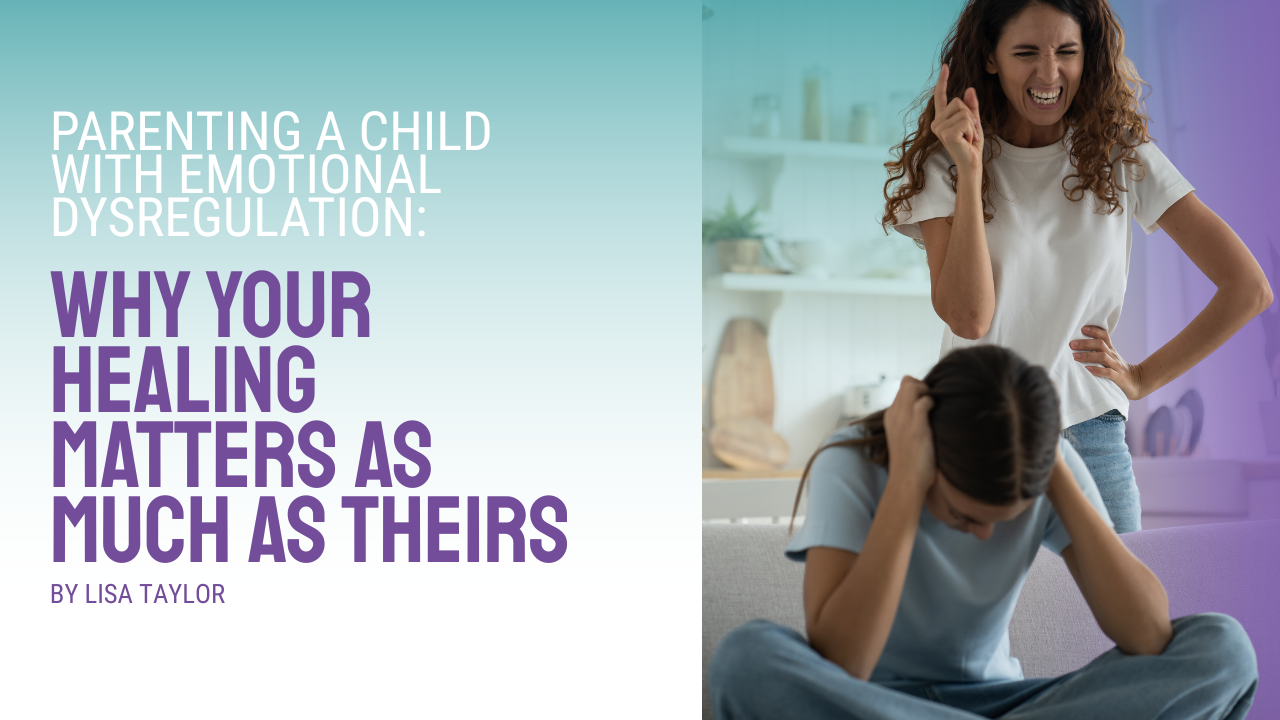
There is a particular kind of tired that comes from loving a child whose emotions can fill an entire house.
The bracing when you hear a door slam. The scanning of their face for signs of what kind of evening this will be. The careful choosing of every word, because the wrong one might set off an explosion — or a shutdown.
Many parents live this way for years.
And most of them are doing it silently. Because from the outside, nobody sees it. And saying it out loud feels like admitting failure.
If this is your home right now, I want you to know something before we go any further: you are not failing. You are living with a nervous system that has been on duty far too long.
On a recent episode of my podcast, Turn the Lens Inward, I sat down with my very first guest — Sheila Marina — for one of the most meaningful conversations I've had since starting the show.
Sheila is a mother who raised a son through complex emotional and behavioural challenges. She knows what it does to your body, your relationships, and your sense of who you are. And she knows what it takes to find your way back.
Her story is different from mine in the details. But the shape of it is one so many parents will recognize.
The overwhelm. The isolation. The shame. And eventually — the turn inward that changed everything.
What Does a Child's Emotional Dysregulation Do to the Whole Family?
When one person in a family is living with emotional dysregulation, the entire family system feels it.
This is something we don't talk about enough.
Emotional dysregulation means a person's emotional responses are bigger, faster, and longer-lasting than the situation seems to call for — and much harder to come down from. For the child, it is exhausting and often frightening. They are not choosing chaos. Their nervous system is overwhelmed.
But here is what parents are rarely told.
Your nervous system is responding too.
When your child is escalated, your body reads it as danger. Your heart rate rises. Your thinking narrows. You move into fight, flight, or shutdown — often before you've consciously registered what's happening.
Over months and years, this becomes your baseline.
Sheila described it honestly in our conversation: the hypervigilance, the strain on her other relationships, the slow erosion of her own identity. When every ounce of energy goes into managing one person's storms, there is nothing left for yourself.
You stop being a woman with a life.
You become a crisis response system.
And no one can live that way indefinitely. Not without the body eventually saying enough.
Why Do Parents Carry So Much Shame?
Of all the things Sheila and I talked about, this may be the most important.
The shame.
Shame that your family doesn't look like everyone else's. Shame about the yelling you wish you could take back. Shame that you sometimes don't like being around your own child. Shame that nothing you've tried has worked — the therapists, the programs, the books, the consequences, the endless conversations.
And underneath all of it, the question that keeps parents up at night:
Did I cause this?
Here is what I want you to hear.
Shame grows in silence. And parents of struggling kids are some of the most silent people I know.
We hide what's happening behind closed doors. We smile at work. We say "we're fine" at family gatherings. We watch other parents post graduation photos and quietly grieve.
But the isolation is not protecting you.
It is starving you of the one thing that actually helps: being seen by people who understand.
That is what both Sheila and I found — separately, years apart — through the same unexpected door.
What Is the Family Connections Program?
When Sheila found the Sashbear Foundation's Family Connections program, something began to shift.
I understood exactly what she meant. Because Sashbear is where my own turning point began too.
Family Connections is a free, evidence-based program for family members of people struggling with emotional dysregulation — including those with a diagnosis, or traits, of borderline personality disorder. It draws on skills from dialectical behaviour therapy (DBT), adapted for families, and it is led by trained facilitators who have lived this themselves.
Here is what makes it different from most parent resources.
It doesn't hand you strategies to fix your child.
It teaches you skills. How to regulate your own emotions. How to communicate in ways that de-escalate instead of inflame. How to validate. How to hold boundaries with compassion. How to stop pouring from an empty cup.
And it puts you in a room — often for the first time — with other parents who get it.
No judgment. No performing. No pretending.
For Sheila, and for me, that room was where the shame finally started to loosen.
Not because someone said the magic words. Because we stopped being alone with it.
How Can Validation Change Your Relationship With Your Child?
One of the first skills both of us learned was validation.
And I'll be honest — when I first heard it, I thought I was already doing it.
I wasn't.
Validation is not the same as agreement. It is the ability to acknowledge another person's emotional reality without needing to correct it, fix it, or talk them out of it.
It sounds like: "I can see why you feel that way."
Not: "That's not what happened." Not: "You're overreacting." Not: "Let me explain why you shouldn't feel like that."
For years, many of us have responded to our children's big emotions with logic, correction, or solutions — because we love them and we want to help. But to a dysregulated nervous system, correction feels like attack. It escalates the storm instead of calming it.
Validation does the opposite.
When a person feels genuinely heard, their nervous system begins to settle. The defensiveness softens. And connection becomes possible again.
Sheila and I both saw this transform our communication with our children.
Not overnight. Not perfectly.
But conversation by conversation, validation rebuilt something that years of fixing never could.
Trust.
What Is Your Nervous System Actually Doing During Conflict?
Sheila and I spent a good part of this conversation on something most parenting advice skips entirely.
The body.
When conflict erupts — the screaming match, the slammed door, the frightening silence — your central nervous system takes over. It is not asking for your opinion. It is running an ancient program designed to keep you alive.
That program has three basic settings: fight, flight, or freeze.
Maybe you recognize your own version:
- snapping back before you can stop yourself
- lecturing louder and faster as they shut down
- walking away and going numb
- lying awake replaying every word
- feeling your chest tighten when their name lights up your phone
None of this means you are a bad parent.
It means your body has been protecting you the only way it knows how.
But here is the hopeful part — and it is genuinely hopeful.
The nervous system can learn. With awareness and practice, you can teach your body that it is safe enough to pause. To breathe. To stay grounded in a moment that used to send you straight into reaction.
And when you stay regulated, something remarkable happens in the room.
You become the calm your child's nervous system can borrow.
Not by suppressing what you feel. By becoming steady enough to feel it without being swept away.
Why Does Healing Yourself Change Your Child?
This is the heart of everything Sheila and I talked about. And it is the heart of everything I teach.
You cannot control your child's healing.
You cannot regulate their emotions for them, force insight, or love them into skipping the hard parts of their own path.
But you are half of every interaction you have with them.
And when your half changes, the dynamic changes.
When you respond instead of react, there is less fuel for the fire. When you validate instead of correct, there is less to defend against. When you hold boundaries calmly, the relationship gets structure without punishment. When you tend to your own old wounds — the subconscious beliefs you've carried since childhood, the patterns you inherited without choosing — you stop bringing yesterday's pain into today's conversation.
This is what turning the lens inward really means.
Not blame. Responsibility.
Not fixing your child. Understanding yourself.
Sheila has taken her healing further into her own practice, Planet of Peace, where she now works with others using modalities including the Emotion Code and Reiki — approaches she found meaningful in releasing what her body had been holding through those hard years. What struck me in our conversation wasn't any single method. It was the deeper truth underneath her story:
She stopped asking only "How do I help my son?" and started also asking "What in me needs care?"
That question changed her family.
It changed mine.
And it is available to you, starting today, at no cost except honesty.
There Is Still Hope. Even Now.
If you are a parent who feels overwhelmed, isolated, or unsure what to do next, I want to leave you with what Sheila and I both know from living it.
Change is possible.
Not because your circumstances will transform overnight. But because you can.
You can learn to regulate your own nervous system. You can learn to validate. You can find rooms full of parents who understand. You can put down the shame you were never meant to carry.
And as your steadiness grows, the emotional climate of your home begins to shift — slowly, imperfectly, one grounded choice at a time.
You are not failing because this is hard.
You are not alone, even though it feels that way at 2 a.m.
And nothing — not the yelling you regret, not the years in survival mode, not the grief of a family that doesn't look how you imagined — nothing is wasted.
It can all become part of the healing. Yours, and theirs.
Listen to the Full Conversation
Hear my full conversation with Sheila Marina on Turn the Lens Inward — including her personal story of raising her son, what the Family Connections program taught her, and how she found her way back to herself.
To learn more about the free Family Connections program, visit the Sashbear Foundation. If this season has left you running on empty, my free guided experience, Living on Autopilot?, is a gentle place to pause, breathe, and begin reconnecting with yourself.
Frequently Asked Questions
What is emotional dysregulation?
Emotional dysregulation means emotions arrive faster, feel bigger, and last longer than a situation seems to call for — and are much harder to recover from. It is a nervous system pattern, not a character flaw or bad behaviour. It is common in people living with intense emotional sensitivity, trauma histories, and conditions such as borderline personality disorder, anxiety, and depression.
How does a child's emotional dysregulation affect parents?
Living with a dysregulated child keeps a parent's own nervous system in a prolonged state of alert. Over time this can look like hypervigilance, sleep problems, anxiety, irritability, strained relationships, emotional exhaustion, and losing your sense of identity outside of crisis management. This is why parents need their own support and healing — not just strategies for their child.
What is the Family Connections program?
Family Connections is a free, evidence-based program from the Sashbear Foundation for family members of people struggling with emotional dysregulation, including borderline personality disorder. It teaches families skills adapted from dialectical behaviour therapy (DBT) — including emotional regulation, validation, and effective communication — in a peer setting led by trained facilitators with lived experience.
What are validation skills for parents?
Validation is acknowledging your child's feelings as real and understandable without needing to agree, correct, or fix. It sounds like "I can see why that upset you" rather than "You're overreacting." Validation helps a dysregulated nervous system settle, reduces defensiveness, and rebuilds trust — often more effectively than advice or solutions.
Why do I react so strongly during conflict with my child?
Because your central nervous system perceives conflict as danger and moves you into fight, flight, or freeze before your thinking brain catches up. Years of stress can make this response automatic. The encouraging news is that nervous systems can learn: with awareness and practice, you can build the capacity to pause, stay grounded, and respond instead of react.
Can healing myself really change my child's behaviour?
You cannot control your child's choices or healing. But you are half of every interaction, and when you become steadier — validating more, reacting less, holding calm boundaries — you change the emotional environment your child responds to. Many families find that a child's behaviour begins shifting after a parent's way of showing up shifts first.
How do I deal with the shame of having a struggling child?
Shame grows in silence, so the most powerful antidote is safe connection — being honest with people who understand, whether in a program like Family Connections, coaching, therapy, or trusted community. It also helps to separate responsibility from blame: you can take ownership of how you show up going forward without carrying the belief that you caused your child's struggles.
Where can parents of struggling teens find support?
Start with support built for parents, not just for your child: the Sashbear Foundation's free Family Connections program, family DBT skills resources, parent peer groups, individual therapy, or coaching focused on your own regulation and boundaries. On Turn the Lens Inward, Lisa Taylor of Glowing Confidence shares conversations and tools for parents walking exactly this road.
— Lisa Taylor is a confidence coach, speaker, and host of the Turn the Lens Inward podcast. Through Glowing Confidence, she helps women move out of survival mode and into emotional steadiness, healthy boundaries, and grounded confidence — one choice at a time.
Feel Like You’re Living on Autopilot?
It's time to hit pause.
This free, guided experience is your pause button. Your chance to step out of the whirlwind and finally see yourself clearly.

Feel Like You’re Living on Autopilot?
It's time to hit pause.
This free, guided experience is your pause button. Your chance to step out of the whirlwind and finally see yourself clearly.
